
Home / Tools / Italic Text Generator
This italic text generator turns your text into italic-looking Unicode characters, so you can copy the result and paste it anywhere as real, selectable text — no image, no installed font.
Flips instantly using real Unicode characters. Letters flip; numbers and unsupported characters stay exactly as typed.
How to Use the Italic Text Generator
- Type or paste your text into the box above.
- Watch the italic version update instantly as you type.
- Click Copy to grab the italic text.
- Paste it anywhere you like, such as a bio, caption, or message.
- Use Clear to start over with new text.
What Is Unicode Italic Text?
Unicode has a block called Mathematical Alphanumeric Symbols, originally added so that math and physics notation (variables, functions, and so on) could be written in bold, italic, script, and other styles without relying on a specific font. Letters in that block are separate characters, not a styled version of the letter "A" you already typed — each one has its own Unicode code point.
This tool swaps each letter in your text for its Mathematical Italic equivalent from that block. Because the result is made of real characters, you can copy it and paste it into places that only accept plain text and have no italic button, like most bios and comment fields.
One detail worth knowing: Unicode never added italic versions of the digits 0–9. Bold, double-struck, and a few other numeral styles exist in the same block, but plain italic digits don't, so numbers in your text stay unchanged rather than being faked with a lookalike character.
Unicode Italic vs Real Italic Formatting
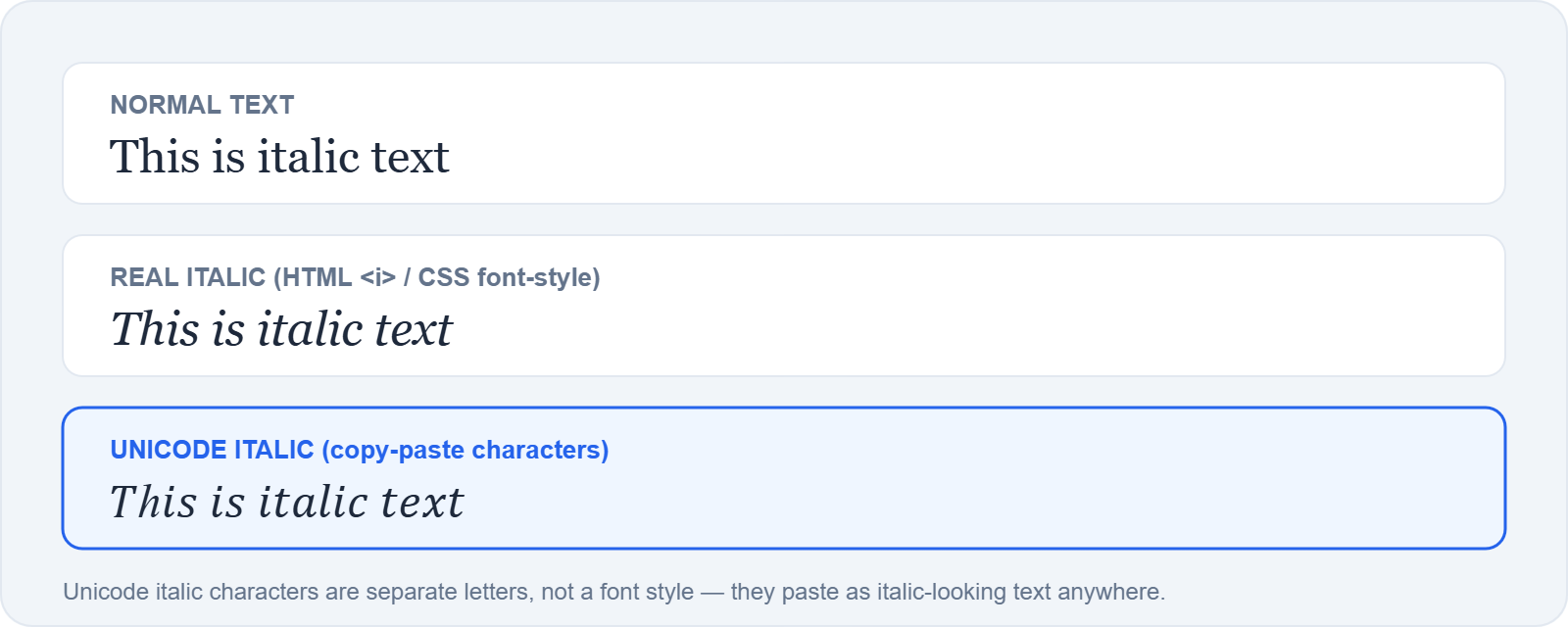
Real italic formatting, the kind you get from the italic button in Word, Google Docs, or an HTML <i> tag, is a style applied to ordinary letters. The underlying character is still a plain "a"; software just tells the screen to slant it. That styling stays editable, is picked up correctly by screen readers, and is searchable as normal text.
Unicode italic text is different: it swaps each letter for a distinct character that happens to look slanted. There's no underlying "plain" version attached to it, no bold/italic toggle, and no guarantee every font or system renders it the same way. It's a clever workaround for places that don't offer real formatting, not a replacement for it.
Where Italic Unicode Text Works — and Where It May Not
It generally works well in social media bios and captions, chat apps, usernames, and anywhere else you can paste plain text. Most modern phones and browsers render the Mathematical Alphanumeric block correctly.
It can misbehave in a few places: some older devices or minimal fonts show blank boxes instead of the character, search engines treat it as an unusual symbol rather than the letter it resembles (so it won't match a normal text search), and form fields with strict character validation may reject it outright. If a site or app truly needs formatted italics, for example in a document or a web page you control, use that platform's actual italic formatting instead.
Compatibility and Accessibility Considerations
Because these are distinct Unicode characters rather than styled letters, screen readers may announce them differently than plain text, spell out each character, or skip them, depending on the reader and its settings. For anything that needs to be fully accessible, such as official documents, headings on your own website, or important instructions, use real italic formatting or plain text instead of Unicode italics.
FAQ
Is this a real italic font?
No. It's a font-independent set of Unicode characters that happen to look italic. No font is installed and nothing is rendered as an image — the output is ordinary, copyable text.
Why don't my numbers turn italic?
Unicode simply never created italic digit characters, so numbers pass through unchanged rather than being replaced with something inaccurate.
Will this work on Instagram, TikTok, and Twitter/X?
Yes, all three accept plain Unicode text in bios and posts, so the italic characters paste in and display normally on most devices.
Why does a character look unchanged after I convert it?
Only the Latin letters A–Z and a–z have a Mathematical Italic equivalent. Accented letters, punctuation, emoji, and characters from other scripts are left exactly as you typed them rather than guessed at or corrupted.
Is this text SEO-friendly or accessible?
Not particularly. Search engines and screen readers generally treat these as unusual symbols rather than the letters they resemble. It's best suited to casual, decorative use rather than content that needs to be indexed or read aloud accurately.
Related Tools
- Cursive Font Generator — turn text into elegant Unicode script letters.
- Small Text Generator — turn text into tiny Unicode capitals.
- Upside Down Text Generator — flip text upside down using verified Unicode characters.
Browse all tools on the Tools page.